
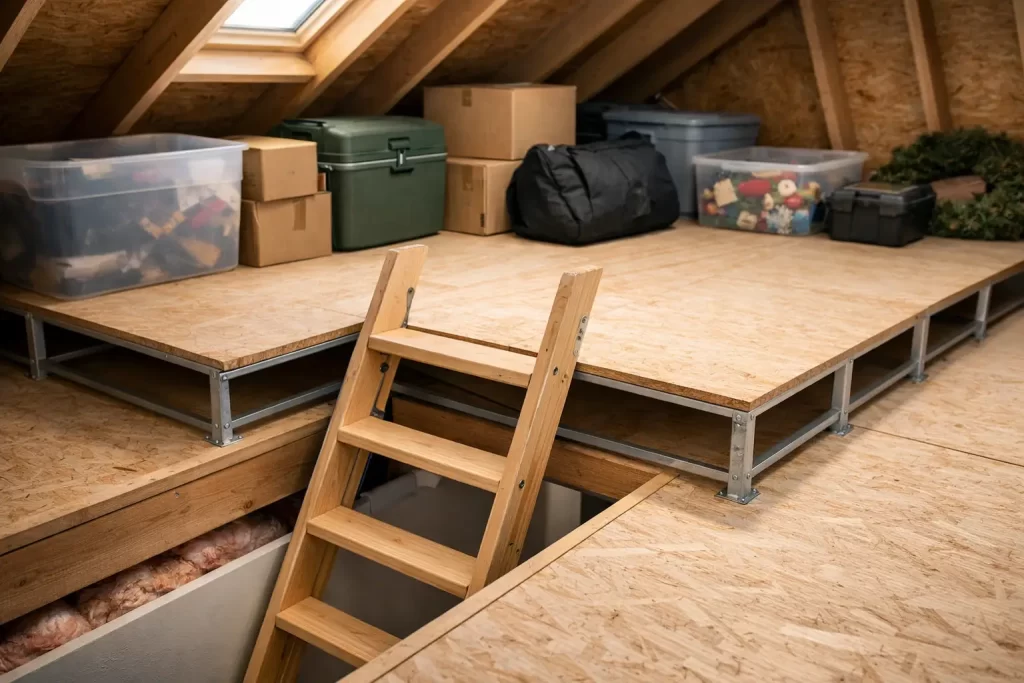
If your attic is full of insulation but still not giving you real storage space, that usually means the floor is the problem, not the room. Raised attic flooring for storage is what turns an awkward, half-usable attic into a practical area you can actually trust with boxes, suitcases, and household items.
For many homeowners, the attic becomes a place for balancing on ceiling joists, shifting items around carefully, and hoping nothing goes through the drywall below. That is not a storage solution. A properly raised floor creates a stable deck above the insulation, so you keep the thermal performance of the attic while gaining safe access and usable storage.
What raised attic flooring for storage actually means
Raised attic flooring for storage is a system built above the ceiling joists to allow insulation to remain at the correct depth underneath. Instead of compressing insulation by laying boards directly on top of it, the flooring is lifted above that layer using a support system, then decked over to create a solid walking and storage surface.
That detail matters more than most people realize. Insulation works best when it stays fluffy and uncompressed. Once it is squashed down, it loses effectiveness. So while direct boarding might look cheaper at first, it can work against the whole point of insulating the attic in the first place.
A raised floor also helps preserve airflow in the attic. That is another area where shortcuts can cause problems. If insulation blocks ventilation paths, moisture and condensation issues can become more likely. A good installation takes both storage and attic health into account.
Why standard attic boarding is not always enough
A lot of older attic storage jobs were done the simple way – boards fixed straight onto the joists. In some houses, especially where insulation levels are low, that may have been common practice. The issue is that modern insulation standards usually require a much deeper layer than the joists alone can accommodate.
That creates a trade-off. Either you protect energy efficiency and lose storage space, or you gain a bit of storage by flattening the insulation. Raised attic flooring avoids that compromise.
There is also the question of safety. Ceiling joists are not a finished floor. They are part of the structure, and stepping between them can be risky. A proper decked area makes moving around easier and reduces the chance of damage below.
When a raised attic floor makes the most sense
This type of flooring is a strong option if your attic is mainly intended for light household storage rather than a full attic conversion. That includes things like holiday decorations, luggage, archive boxes, baby gear, and other items you need out of the way but still accessible.
It is especially useful if you already have decent insulation in place and do not want to undo that benefit just to create a platform. Homeowners who are short on closet space often find that a raised attic floor gives them meaningful extra capacity without taking on the cost or disruption of a larger renovation.
That said, not every attic is the same. Roof shape, joist layout, insulation depth, head height, and access all affect what is practical. Some attics are ideal for a large storage area. Others are better suited to a smaller decked section around the hatch and ladder. The right answer depends on how you plan to use the space.
The real benefits of raised attic flooring for storage
The biggest benefit is simple: you get usable storage space without undermining your insulation. That is the main reason homeowners choose it.
The second benefit is safer movement in the attic. A solid decked section makes it easier to carry boxes, reach stored items, and move around without awkward footing. If the attic is accessed regularly, this matters a lot.
There is also a convenience benefit that often gets overlooked. Once the attic has a proper ladder, a stable raised floor, and a clear storage zone, people actually use it. Before that, the attic tends to become wasted space because getting in and out is too much hassle.
A clean, professionally fitted raised floor can also make the home feel more organized overall. It is not flashy, but it solves a very common problem in a practical way.
What a good installation should include
A proper raised attic flooring job is not just about laying boards. The structure beneath the boards needs to be suited to the attic, the insulation depth, and the expected storage use. The finished deck should be stable, level, and fitted in a way that respects ventilation and insulation performance.
The access point matters too. In many homes, attic flooring only makes sense when paired with a safe attic ladder and a properly sized hatch. If access is awkward, narrow, or unstable, even the best storage floor will not be as useful as it should be.
Insulation and airtightness are part of the picture as well. If the attic opening is poorly insulated or badly sealed, heat loss can still be an issue even after the floor is done right. That is why many homeowners prefer a complete package rather than piecing the job together through separate trades.
Common mistakes homeowners try to avoid
The most common mistake is DIY boarding directly over insulation. It looks straightforward, but it usually creates problems with insulation compression, uneven flooring, or limited ventilation.
Another issue is assuming every attic can take the same storage load. Attics meant for light storage are not the same as rooms designed for regular occupancy. A professional assessment helps set realistic expectations about what can be stored and where.
Poor access is another weak point. Folding steps that feel unstable, small hatches, and badly positioned openings can make attic storage more frustrating than useful. Flooring and access should work together.
Mess is also a real concern for homeowners. Attic work can involve insulation, dust, cutting, and movement through the house. A specialist installer should already have a clear process for protecting the home and leaving the area clean when the job is done.
Is it worth paying for professional installation?
For most homeowners, yes. Raised attic flooring for storage sounds simple until you factor in insulation depth, structural layout, ventilation, access, and finish quality. This is one of those jobs where a rushed or poorly planned installation can leave you with a space that is awkward, inefficient, or only partly usable.
A specialist brings speed as well as experience. They can usually assess the attic quickly, recommend the right approach, and complete the work with far less disruption than a drawn-out DIY project. That matters if you are trying to improve storage without turning the house upside down for weeks.
There is also value in having one company handle the full setup. If the attic needs a ladder, hatch upgrade, insulated door, or handrail along with the raised floor, an all-in-one service is usually the cleaner option.
What to ask before booking the job
It helps to ask how much storage area is realistic in your attic and whether the proposed floor will sit above the insulation rather than on it. You should also ask what kind of items the space is intended to hold, how access will work, and whether the installer includes cleanup as part of the service.
If you are comparing quotes, do not just compare square footage. Look at what is actually included. One price may cover only basic boarding, while another includes the raised substructure, attic ladder, insulated hatch, and finishing details that make the space genuinely usable.
Homeowners in places like Dublin often want the same thing: a straightforward job, clear pricing, and a finished attic space that feels safe and worth the investment. That is why specialist providers such as AOS Attic Ladders & Flooring focus on complete fitted solutions rather than one-piece fixes.
A smart upgrade for homes short on storage
Raised attic flooring for storage is not about overbuilding the attic. It is about using the space properly. If your home needs more room for everyday storage, and your attic is currently hard to access or risky to use, a raised floor can make a noticeable difference without major renovation work.
Done right, it protects insulation, improves access, and gives you storage space you will actually use. And for busy households, that kind of practical improvement tends to pay for itself in less clutter, less hassle, and a home that works better day to day.
If your attic already has the space, the next step is making sure it is fitted out in a way that is safe, efficient, and built to last.